
Introduction
On June 16 2019, Sam Levinson debuted his pilot episode of, “Euphoria”, on HBO. The show found major success among the teenage demographic as it is centered around and narrated by a 17-year-old Ruby (Rue) Bennett. Rue is a bi-racial, queer, drug-addicted highschooler, surrounded by a cast of individuals who each suffer and represent a different mental health struggle. The show found its popularity through its authentic, raw presentation of mental health
Character Breakdown
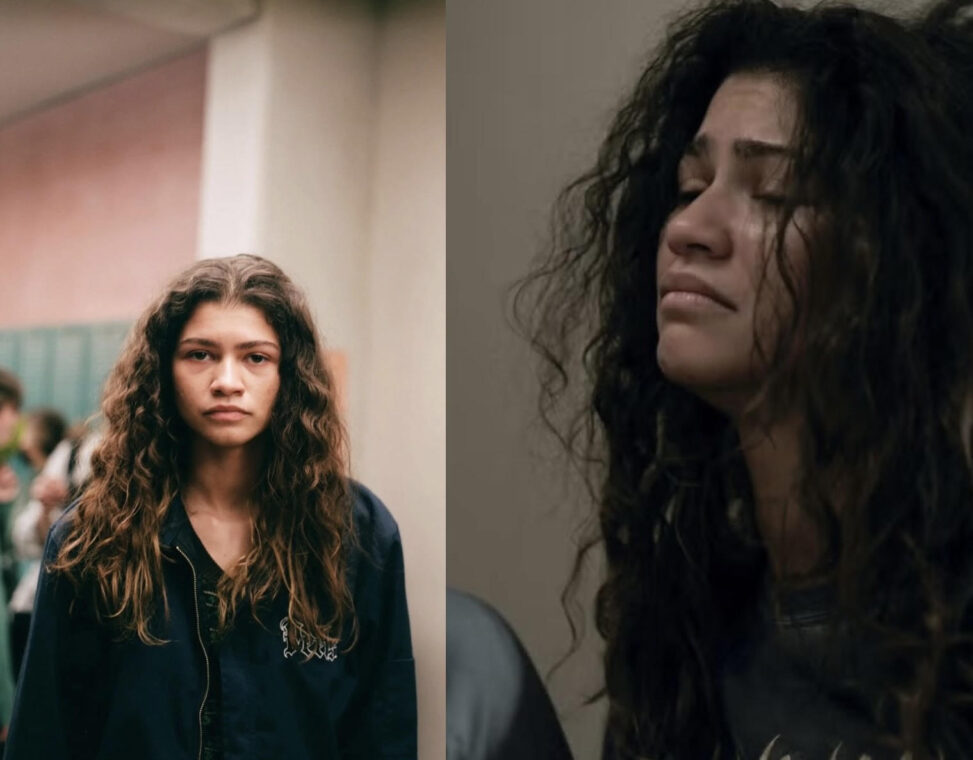
The character of Rue is one that is complex and layered. She should have been the representation of the ‘troubled teen’ stereotype, along with being stereotyped for her ethnicity and sexual orientation. However, Zendaya, the actress who portrays Rue, is able to represent her in a way that strays from those stereotypes and prejudices. Rue’s addiction spans throughout the series, triggered by her fathers passing. This causes her addiction to be one stemming from pain and loss rather than one of partying or approval. Rue is self-aware, taking responsibility for her mistakes and addiction. She is able to narrate when she’s hurting, lying to, or manipulating someone, and articulate the pain she feels from doing so. She is not in denial; she boldly claims her addiction. Rue’s love for her family and friends breaks the stereotype of isolating and losing family due to drug use. Her love is intense, as she often views herself as a protector. Along with her addiction, Rue suffers from Bipolar Disorder, Obsessive-Compulsive Disorder, and panic attacks. Through this depiction, Rue is not villainized as a danger or a villain. Rue’s character garners empathy from the audience as she is portrayed as a teenager living with mental health issues.
The real-life implications of, ‘Euphoria’, comes with pros and cons. The show’s ability to showcase mental health issues, including ones that aren’t represented mainstream such as Compulsive Sexual Behavior shines a light on marginalized communities who may feel ignored by society. The idea that drug use and addiction is complex and can be overcome provides a safe space for audience members either struggling with or who overcame addiction. The scenes and content are explicit and sexual in nature. Rue’s scenes involving drug use are graphic, showing her administering the drug. Her scenes show signs of being under the influence, as strobe lights, party music, and camera effects depict her mental state. These scenes of drug use, and the idea that a high is fun can be damaging to youth who watch the show out of curiosity.
We see two depictions of Rue throughout the series. In season one, 17-year-old Rue is beginning her journey with drugs. She experiences highs for the first time, finding tranquility. She spends most of her time at parties with friends, dismissing the judgement from family and her sponsor. This changes by the beginning of season two as we witness Rue in the midst of sobriety. Now 18-years-old, Rue faces the struggles of withdrawal with the support of her family. With a clear mind, she is able to express her remorse for the pain she inflicted on others. She seeks out reconciliation with family, and returns meetings with her sponsor. Taking that big of a step after turning 18-years-old reflects the real-life implications that come with turning 18. Now in charge of making your own decisions, you must decide whether you will better yourself, or continue to live your teenage years. Rue’s step towards sobriety shows her willingness to better herself.
Character Construction
A study conducted by Zakiye Ghelbash et. al. (2025) aimed to identify psychosocial health promotion-related needs of adolescent Iranian girls with substance abuse. They found that most of their participants had reported experiences trauma during their childhood. A law enforcement officer contributed to the study stating, “… in my opinion, children go into addiction sooner in a family that has suffered itself” (Zakiye Ghelbash et al. 2025). We can relate these facts to Rue beginning her addiction following her father’s death. The shows depiction of teenagers doing drugs is not make belief. A 2003 study gathered LGBTQ and street youth from drop-in clinics, questioning them on substance use and attempts at recovery. Results showed 43% reporting drug use within the last week while 46-57% report using daily. The LGBTQ participants alone reported 24% of usage. Sadly, Rue falls into both of these categories as she identifies as queer, and uses daily. Jason Nicholson et. al. conducted a study to examine adolescent use of pain relievers. They noted, “those who abuse pain relievers have increased odds for alcohol and substance use, overdose, depression…” (Nicholson et al. 2024). A season two scene shows Rue suffering from an overdose after relapsing. Before getting sober, her drug of choice was opioids. Nicholson’s assertion that pain relievers can lead to drug abuse suits Rue’s character arc, while also reflecting real world experiences faced by teens.
BIBLOGRAPHY
Martin, Ian, Thomas M. Lampinen, and Doug McGhee. 2006. “Methamphetamine Use among Marginalized Youth in British Columbia.” Canadian Journal of Public Health 97 (4): 320–24. https://doi.org/10.1007/bf03405613.
Nicholson, Jason, George E. Higgins, Sifat Rahman, Frederick A. Williams, and Catherine D. Marcum. 2024. “Adolescent Nonmedical Use of Prescription Pain Relievers: An Examination of Primary Socialization Theory.” Journal of Substance Use 30 (3): 440–46. https://doi.org/10.1080/14659891.2024.2347387.
Zakiye Ghelbash, Mousa Alavi, Mahnaz Noroozi, and Masuood M. Far. 2025. “Psychosocial Health Promotion‐Related Needs in Adolescent Girls with Substance Abuse: A Qualitative Study.” Perspectives in Psychiatric Care 2025 (1). https://doi.org/10.1155/ppc/4744447.
Nevaeh Servia
Catenaccio’s work depicts a unique take on the project. The idea of comparing two different versions of a character played by the same actor was a refreshing take. I appreciate her in-depth research into addiction within real queer and minority communities using verifiable sources such as The Canadian Journal of Public Health. This integration of real-life effects of drug use made the character comparison and the work itself incredibly strong. The shifts between the life of the character and the lives of real queer youths are particularly flawless, which made the work very enjoyable and educational.
The text evaluates the main character of a popular HBO original, Euphoria. The main character, Rue, becomes addicted to drugs due to her father’s fatal illness and eventual death. This work compares the same character between the two drastically different seasons. Catenaccio’s evaluation of this was incredibly strong. She explores how different life becomes as teenagers become adults and how that is reflected within Rue’s character as she begins to make her own life choices. Between both seasons she shifts from a user who does not care to seek help to a user who is trying to seek reconciliation with her family and herself, which, as someone who watched Euphoria, is a very in-depth take on a character that many people only view as a mentally ill addict, despite her character shift.
This work is extremely strong structurally and contains very strong sources. Though it could’ve been even better by expanding on the camera work and shading shift between both seasons as Rue’s character begins to shift. The show is known for its very telling cinematography and how it illustrates changes in characters and their emotions towards themselves and each other. An additional paragraph on this would’ve further strengthened the work and its comparison of Rue’s two versions of herself.
Overall, I really enjoyed Catenaccio’s take on Rue’s different character depictions and how her character’s addictions and mental illnesses are reflections of real-life issues faced by queer youths today. Her work is extremely strong and meets each point of the criteria.