
Most Recent Hollywood Action Film
I watched John Wick: Chapter 4 (2023) which stands as my most recent Hollywood action film experience. The movie maintains its trademark action elements through perfectly choreographed gunplay and neon-lit environments and visually striking settings which elevate physical combat into sophisticated action sequences. The film depends on visual narration to create tension through deliberate lighting effects and costume design and environmental elements when characters remain inactive. The film presents an excellent opportunity to study mise-en-scène and editing techniques and violent content representation in modern action movies.
Mise-en-Scène, Editing, Violence, Character Representation & Camera Style
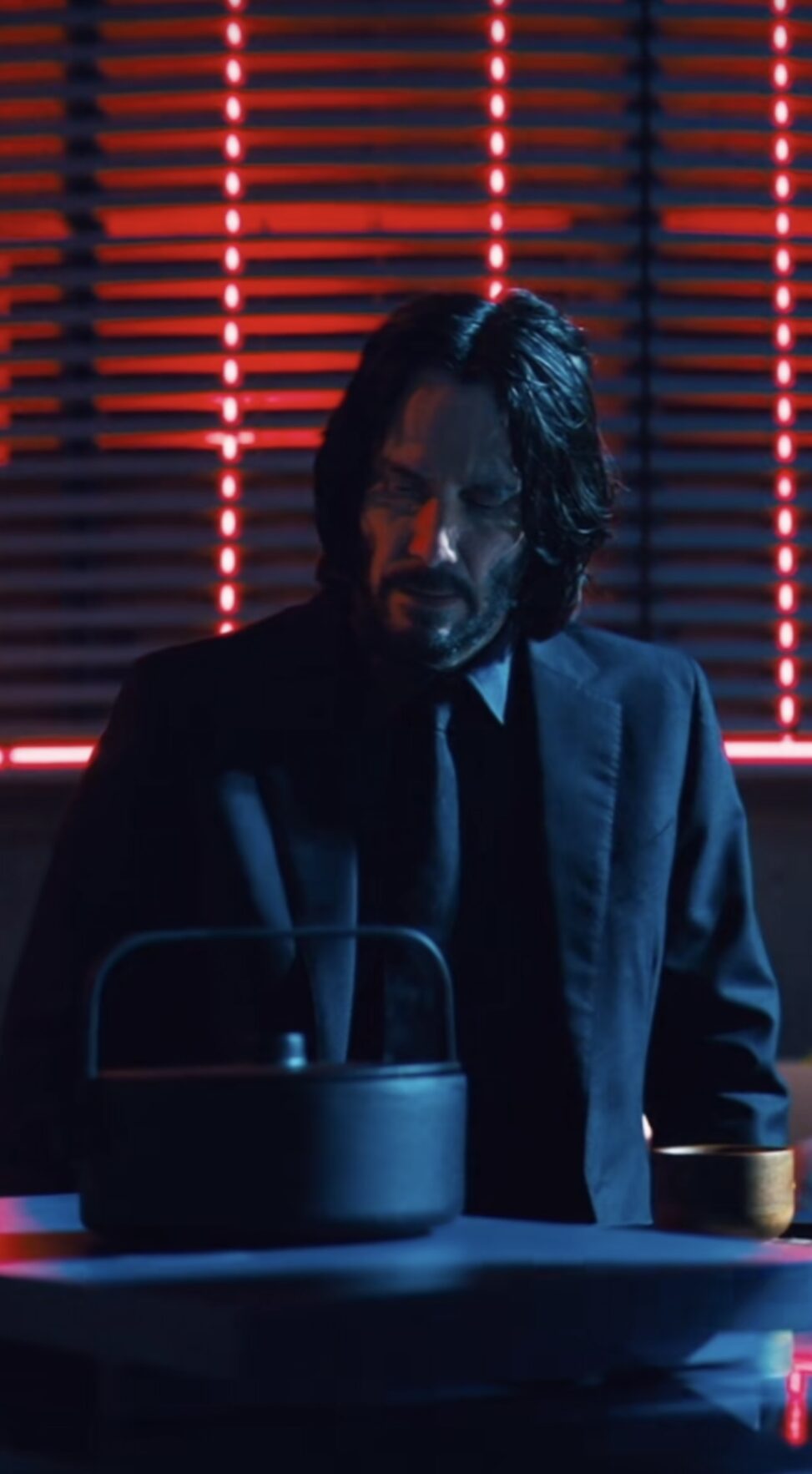
The screenshot depicts John Wick sitting at a table inside the Osaka Continental hotel while deep red and blue neon lights illuminate the space. The horizontal red LED lines in his blinds create a perfect visual pattern which maintains an equal distance between each line. The controlled lighting system in this scene creates an emotional atmosphere. Research indicates that visual and auditory elements in movies determine how viewers predict events and manage tension during inactive moments.^1 The dangerous signals emerge from the red lighting yet Wick’s face displays blue tones which create a sense of control and serenity.
Wick maintains a straight posture while showing complete composure. His unscathed appearance demonstrates his internal strength and self-control despite the dangerous situation that surrounds him. The black suit maintains its perfect condition to showcase his assassin persona as a highly trained and focused professional. Research on film perception demonstrates that viewers develop emotional predictions through small physical signals including facial immobility and body position which intensify tension before action starts.^2 The stillness of Wick during this instant demonstrates his controlled power and his readiness for upcoming events instead of showing any signs of weakness.
The tea set on the table brings cultural significance to the Osaka environment through its placement. The film presents a visual conflict between the peaceful tea arrangement and its violent storyline through its contrast between ritual and brutality. Research shows that film environments through their objects and settings help viewers build emotional connections to scenes.^3 The minimalist design and symmetrical lighting in this scene establish a peaceful atmosphere which leads viewers to expect an upcoming conflict. Through his motionless position the mise-en-scène indicates that danger is drawing near.
The screenshot shows a peaceful scene but the following sequence contains fast-paced editing with numerous cuts. The sequence leading up to this shot and following it contains approximately 40 to 50 editing cuts which show close-up character views and wide shots of combat as the Continental hotel faces an attack. Research indicates that quick audiovisual changes between scenes create powerful effects on audience perceptions of suspense and timing.^4 The camera follows Wick at a slow pace before the scene ends with a wide-angle view that shows enemies and increasing movement. The brief pause functions as a visual pause which intensifies the audience’s anticipation.
The characters in this scene follow established action genre conventions through their depiction. The action genre in cinema shows male heroes who maintain emotional control while demonstrating physical abilities through Wick’s composed body language. The character’s injury-free state creates an impression of readiness and self-assurance which upholds the myth of the indestructible action hero that viewers understand through visual signals and genre conventions. Research on film cognition demonstrates that brief peaceful moments in violent stories affect how viewers evaluate character abilities and emotional states.^5 Through visual elements Wick demonstrates his readiness and mastery of situations.
The entire sequence demonstrates the franchise’s distinctive method of presenting violence through stylized and choreographed sequences. The film presents violence through precise and elegant and rhythmic sequences instead of showing it in a realistic manner. The artistic methods used in film production create specific viewer experiences that make action sequences appear both purposeful and enjoyable to watch. Research indicates that film designers use visual and auditory elements to modify audience memories and interpretations of intense cinematic moments.^6 The stylized presentation in John Wick: Chapter 4 transforms violent sequences into a theatrical experience instead of presenting them as unfiltered violence.
Box Office Performance
John Wick: Chapter 4 is the highest-grossing movie in the franchise after earning $187 million in the United States and $432 million worldwide (Box Office Mojo).
Real-Life Consequences for Viewers
Even though real-world violence is not caused by action films, the representation of violence can impact the perception of toughness, emotional control, and the real-world effects of violence. Because of John Wick, the audience may be desensitized to violence due to the way the movie represents it as rhythmic with no serious repercussions. Calm, collected, and stoic characters who do not express fear such as the main character may reinforce social expectations of behavioral stoicism. Research that studies the way movies can impact the way the viewer remembers something demonstrates the ability movies have to lessen the emotional impact of violence.’ This can lead people to believe that there is such a thing as an acceptable response to violence and conflict.
Bibliography
Kläffling, Lukas, Jakob Sittel, and Markus Huff. 2024. “Modality Influences Perceived Film Suspense but Not Time Perception.” Psychology of Aesthetics, Creativity, and the Arts. https://doi.org/10.1037/aca0000684.
Ledo-Andión, Margarita, Ana López-Gómez, and Enrique Castelló-Mayo. 2017. “The Role of Original Version Cinema into the European Digital Space.” Comunicar: Media Education Research Journal 25 (51): 73–81.
Williams, R. A., Maus, G., & Styles, S. J. 2025. “False Memory at the Movies: Experimentally Inducing False Visual Memories Through Sound Design in Two Cuts of a Creative Narrative Fiction Film.” Psychology of Aesthetics, Creativity, and the Arts. https://doi.org/10.1037/aca0000808.
Rawle Fletcher
The student’s analysis of John Wick: Chapter 4 presents a detailed and thoughtful examination of the film’s visual style, particularly through its emphasis on neon lighting, color contrast, and John Wick’s composed physical presence. Overall, I agree with several aspects of their assessment, especially their explanation of how the red and blue tones in the screenshot work together to build emotional tension. Their observations are grounded in the film’s recognizable visual identity, and they demonstrate a strong understanding of how mise-en-scène shapes audience perception.
The student also integrates scholarly research effectively, using their sources to support claims about viewer anticipation, emotional prediction, and cognitive responses to visual cues in film. While these connections enrich the analysis, there are moments where the writing becomes repetitive. Several paragraphs restate similar ideas about Wick’s calmness, audience tension, and genre conventions. A more concise and selective approach to the research would make their argument clearer and more focused.
Despite the occasional repetition, the student successfully broadens the discussion beyond the single screenshot. They connect the image to editing techniques, action-genre expectations, and the franchise’s stylized approach to violence. These broader considerations show that they are thinking critically about how a single still image fits within a larger cinematic sequence.
The image they selected is an appropriate and accurate illustration of their claims. The contrasting neon colors, Wick’s posture, and the cultural elements of the Osaka setting all support the points made in their analysis. The still frame clearly aligns with their interpretation and strengthens the overall piece. Overall, the student’s work is well-developed and insightful, though it would benefit from tighter organization and reduced repetition.