
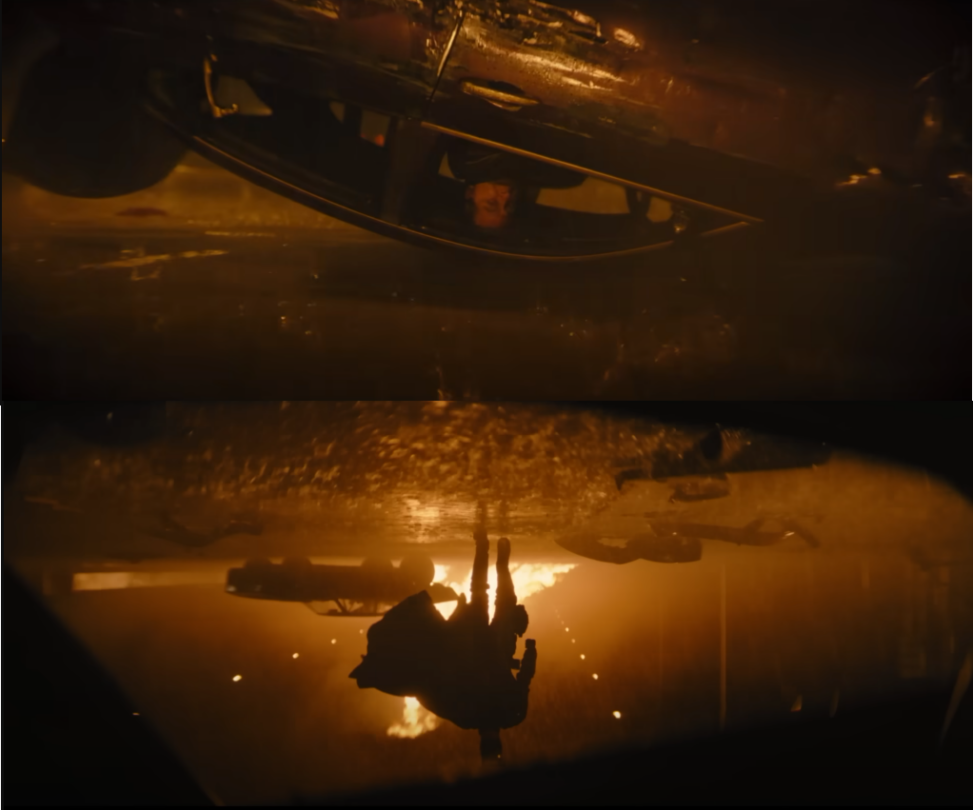
The image I captured comes from the conclusion of the Batmobile chase sequence in The Batman (2022). In this moment, the camera frames the Penguin upside down through the window of his overturned car while Batman approaches through fire and rain. The mise-en-scène of the shot is dominated by a monochromatic palette of oranges and blacks, produced by flames, headlights, and wet asphalt reflecting light across the frame. The low-key lighting and strong backlight create an iconic silhouette of Batman, emphasizing his imposing figure and moral ambiguity. It also puts us in the point of view of the Penguin making it seem like we are actually present in that situation. The burning cars, debris makes up the ecology chaos. This is a scene often seen in action films.
The Screenshot taken puts focus on Batman’s physicality, costume, and iconic silhouette. His body language communicates controlled power, contrasted against Penguin’s helplessness within the overturned vehicle.
Costuming and props-especially through the armored Bat-suit and the wrecked muscle-car Batmobile-emphasize how, within this film’s depiction of violence, technology and masculinity are interlinked. Race and ability are also both relevant here; the able-bodied white male hero, Batman, remains central as protector and aggressor. Penguin, similarly figured here as a white male, is more specifically rendered as an object to be overcome within this violent spectacle rather than as a multidimensional character, which reflects the genre’s tendency to flatten antagonists into functional narrative devices (Tasker, 2015).
To understand the editing in this action sequence, I looked at a roughly one-minute segment surrounding this moment. Over that minute, there are roughly 34 edits, fast but not frenetic compared to something like John Wickor Fast & Furious. The pattern of shots shifts back and forth between POV shots from inside Penguin’s car, wider shots of the flaming crash site, and medium tracking shots of Batman advancing. These repeated POV shifts create a rhythmic tension: the viewer flicks between aligning themselves with Penguin’s fear, watching Batman as unstoppable force, and seeing the chaos of the environment. Camera movement contrasts stillness with sudden motion; while earlier parts of the chase involve high-speed tracking and handheld camera movements, this end sequence is slow, letting the audience take in the imagery. The slow advance of Batman and the long focal length makes this feel inevitable. While the movement of the camera is naturalistic-appearing and immersive, the heavy stylization of lighting, rain, and symmetry of upside-down framing draws attention to the artificial construction of the shot. Viewers become consciously aware of the camera because composition is too perfect, too painterly to feel incidental.
The editing is similarly both seamless and noticeable. On one hand, continuity editing sustains spatial coherence across the scene. On the other hand, the dramatic cut from Penguin’s inverted POV to Batman’s silhouette is intentionally jarring; it reminds the viewer that the moment is constructed to produce an emotional effect. This is consistent with what Bordwell 2006 calls “intensified continuity,” a style in which classical continuity is preserved but overlaid with faster cutting, more dynamic angles, and heightened spectacle.
The image melds together many of the themes of action movie violence based on spectacle, masculine embodiment, urban decay, and stylized movement. Scholars note that modern action films often mix realism with hyperstylization, especially through highcontrast lighting and digital color grading (King, 2000). The Batman’s orangeandblack color palette engages directly with this trend through a graphic novel–type aesthetic that can ramp up the violence but maintain a non-realistic feel. The focus on a hero whose dominance is established through his body and technology also follows from Tasker’s (2015) argument that action cinema propagates a specific white, hyper-competent form of masculinity.
Ecology of destruction-flames, overturned cars, and nighttime rain-is also emblematic of what Lisa Purse (2011) frames as “material expressivity,” where environments become expressive elements in violent action scenes. In this shot, the burning wreckage serves not only as illumination but as a metaphor for the moral decay of Gotham. The flipped frame speaks to what Jeffords (2004) claims about the genre’s inclination to play with identification and locate the viewer within the psychological subjectivities of both heroes and villains.
At the box office, The Batman was a commercial success. According to Box Office Mojo, the movie grossed about $772 million worldwide, emerging as one of the highest-grossing films in 2022.
Though whether films like The Batman have real consequences for viewers remains a matter of debate, scholars generally point out that stylized violence can shape audience perceptions of masculinity, justice, and heroism. Action movies routinely incorporate scenes of violence that are both justified and cathartic, which risks normalizing aggressive problem-solving as heroic (Purse, 2011). Beyond that, the romanticizing of surveillance, revenge, and vigilantism may form cultural expectations about policing or criminal justice. Because the violence in The Batman is so highly stylized and morally knotty, its most important effect may be aesthetic rather than imitative. Rather than encouraging violence, it likely reinforces cultural narratives about trauma, power, and retribution.
(King 2000.)
Bibliography
Bordwell, David. 2006. The Way Hollywood Tells It: Story and Style in Modern Movies. Accessed 12 1, 2025. https://www.ucpress.edu/books/the-way-hollywood-tells-it/paper?utm_source=chatgpt.com.
Jeffords, Susan. 1993. Hard Bodies: Hollywood Masculinity in the Reagan Era. Accessed 12 1, 2025. https://www.ubcpress.ca/hard-bodies?utm_source=chatgpt.com.
King, Geoff. 2000. Spectacular Narratives: Hollywood in the Age of the Blockbuster.
Fatima Keita
The student’s analysis of The Batman’s car-chase ending is extensive and persuasive, and I mainly agree with their judgment of the scene’s heightened stylization and masculine embodiment. They successfully widen their discussion beyond personal observation, combining prominent scholars such as Bordwell, Tasker, and Purse to position the scene within wider discussions on action-film aesthetics and genre standards. Their use of words like “intensified continuity,” “material expressivity,” and hypermasculine performance illustrates a good connection between theory and close reading. Their use of phrases like “intensified continuity,” “material expressivity,” and hypermasculine performance demonstrates a strong relationship between theory and close reading.
The image they selected is a fitting and powerful illustration of their argument. The upside-down frame, black-orange colors, and bold shape make their messages about stylized violence and viewer connection clear. They pay close attention to the shift in perspective from Penguin’s limited viewpoint. The screenshot highlights how the film visually represents power and vulnerability.
However, the analysis sometimes attempts to cover too many areas—masculinity, race, editing rhythm, genre, spectatorship—which can weaken the focus. The brief mention of race feels less developed compared to the other points. Nevertheless, the essay shows a clear understanding of how editing and mise-en-scène work together to create meaning in action movies. The visual evidence strongly backs up the student’s viewpoint.