
The Visceral Symphony: Violence, Spectacle, and the Contemporary Action Film in Extraction 2
Hollywood’s action genre has long been a playground for kinetic energy, explosive set pieces, and the larger-than-life hero. Yet, as the genre has evolved, so too has the way it constructs and presents violence, often leaning into a heightened sense of spectacle that scholars have sought to unpack. The recent Netflix hit, Extraction 2, with its relentless pace and jaw-droppingly brutal sequences, offers a potent cases study for examining these contemporary trends. By analyzing its defining moments through critical scholarly lenses, we can understand how films like Extraction 2 not only entertain but also engage with, and are shaped by, broader discussions within the genre regarding violence, narrative, and audience perception.
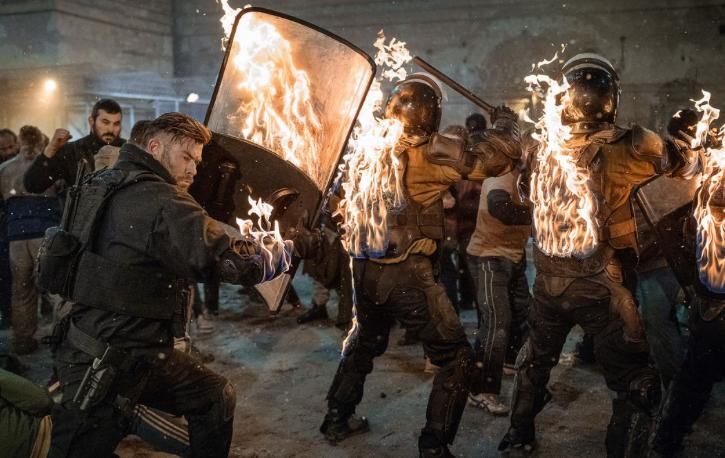
Extraction 2, continuing the saga of former special forces operative Tyler Rake, plunges viewers back into a world of high-stakes danger. One of the film’s most indelible sequences is the sprawling prison riot, a masterclass in chaotic, sustained action. This scene, set within the grim confines of a Georgian penitentiary, is a visceral assault on the senses. The visual environment is deliberately claustrophobic and oppressive: dark, smoke-filled corridors, flickering lights, and the cacophony of desperate men engaged brutal combat. The degree of violence is exceptionally high, escalating from brutal hand-to-hand altercations to close-quarters gunfire and the makeshift use of prison implements as weapons. The speed of violence is relentless, characterized by rapid-fire editing and dynamic camera movements that immerse the viewer directly into the fray. This creates a palpable sense of urgency and disorientation, mirroring Rake’s own desperate fight for survival. The quality of violence eschews clean, stylized choreography for a gritty, unflinching realism, where impacts feel weighty and consequences are starkly rendered. The ecology of the action sequence is confined, trapping Rake and his adversaries within the prison’s brutal architecture, amplifying the sense of desperate struggle.
This heightened presentation of violence and spectacle is not unique to Extraction 2 but is, in fact, a hallmark of contemporary action filmmaking. Nicholas Mirzoeff, in “Spectacle, Narrative and Ideology,” argues that modern films, particularly those in the action genre, often rely on “visual access” as a primary mode of engagement. For Mirzoeff, spectacle can sometimes serve to overshadow narrative depth, prioritizing immediate sensory impact over complex thematic exploration. Extraction 2’s prison riot scene riot scene, with its continuous “one-shot” aesthetic that cleverly masks numerous edits, exemplifies this. The sheer visual information and constant motion demand the viewer’s attention, creating an overwhelming, almost hypnotic experience. The film’s strategy is to bombard the audience with action, making it difficult to pause and question the deeper meaning, instead compelling them forward through sheer momentum.
Furthermore, the genre’s inclination towards intense violence often intersects with discussions about its thematic function, or lack thereof. Arthur Knight, in “Violent Acts: A Study of Contemporary Screen Violence,” explores the psychological dimensions of screen violence, noting how repeated exposure can lead to desensitization and the normalization of aggressive behaviors. While Extraction 2 is primarily concerned with Rake’s mission and survival, the pervasive, almost casual brutality within the prison riot can be seen as contributing to this phenomenon. The film doesn’t dwell on the moral implications of each violent act; instead, it presents them as necessary steps in the larger conflict. This aligns critical observations about how action films can sometimes employ violence as a plot device that drives the narrative forward with minimal introspection, thereby potentially desensitizing audiences to its real-world implications.
Paul Schrader, in his seminal “Notes on Film Noir,” discussed how violence in earlier genres could imbue narratives with a sense of moral ambiguity and existential dread. While Extraction 2is a more modern action film, its relentless brutality can, paradoxically, evoke a different kind of existential experience. Rake is a character perpetually facing death, and the extreme violence he encounters and perpetrates underscores the precariousness of life in the world. This isn’t necessarily a direct parallel to film noir’s moral complexities, but it highlights how violence, even in its most spectacular forms, can be used to articulate certain worldviews-in this case, a bleak, hyper-masculine vision where survival often ephemeral, cast of characters within the riot also reflects the increasingly globalized and varied cultural backdrops are frequently utilized to create diverse arenas for conflict.
REFERENCES
Tyler Rake, plunges viewers back into a world of high-stakes danger.
Nicholas Mirzoeff, in “Spectacle, Narrative and Ideology,” argues that modern films, particularly those in the action genre, often rely on “visual access” as a primary mode of engagement. For Mirzoeff, spectacle can sometimes serve to overshadow narrative depth,
Arthur Knight, in “Violent Acts: A Study of Contemporary Screen Violence,” explores the psychological dimensions of screen violence, noting how repeated exposure can lead to desensitization and the normalization of aggressive behaviors.
Paul Schrader, in his seminal “Notes on Film Noir,” discussed how violence in earlier genres could imbue narratives with a sense of moral ambiguity and existential dread.
Lakshyadeep singh sandhu(T00729505)
The student’s evaluation of Extraction 2 is greatly enhanced by the screenshot they provided. The picture depicts Tyler Rake crashing into a burning riot shield as multiple armored guards nearby are also covered in flames. Aligns perfectly with the student’s description. The dim industrial lighting the smoke filling the air and the continuous motion of people all contribute to conveying the confined and intense atmosphere of the prison riot. The screenshot further reinforces the student’s argument regarding the “and brutal violence—everything appears threatening, immediate and tactile.
I agree with the student that this scene demonstrates the dependence of contemporary action movies on spectacle and intense visuals to maintain interest. Nevertheless although the student refers to Mirzoeff, Knight and Schrader their concepts are not thoroughly tied back to the scene. For instance Knight’s thoughts on audiences becoming numb, to violence could be explicitly associated with the rapid cuts and the simulated “one-shot” technique. In a way Schrader’s concepts regarding violence and emotional strain might be more explicitly connected to the film’s visual style and rhythm.
Overall, the screenshot and the analysis work well together, but the essay would be stronger if the scholarly sources were more deeply connected to the student’s observations.